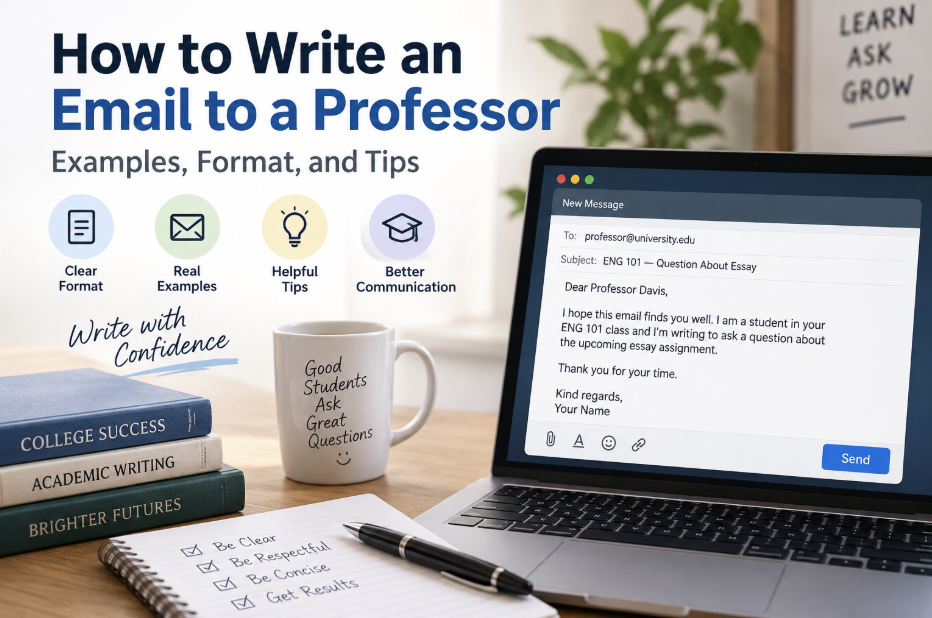
Writing to a professor is a normal part of college life, but the message still needs the right tone. Whether you are asking about an assignment, requesting an extension, arranging office hours, or following up, your email should be clear, respectful, and easy to answer.
If you are learning how to write an email to a professor, focus on a useful subject line, a polite greeting, and a direct explanation of what you need. Professors may receive many messages each day, so a short, organized email is more likely to get a helpful response.
What Makes a Good Email to a Professor?
A good academic email is professional without sounding unnecessarily formal. It should quickly tell the professor who you are, which class you attend, and why you are contacting them.
A strong email usually includes:
- A specific subject line
- A respectful greeting
- Your name and course details
- A clear question or request
- A polite closing
- Your full name or student information when needed
These elements make a professional email to a professor easier to read and reduce the chance of confusion.
8 Steps for Writing an Effective Email
1. Use Your University Email Address
Whenever possible, send the message from your official university account. It helps confirm that you are a current student and reduces the chance of your message being filtered as spam.
2. Write a Clear Subject Line
Your subject line should explain the reason for the email before the professor opens it. Include the course name or code when relevant.
Examples:
ENG 101 — Question About Essay Requirements
BIO 204 — Request for Office Hours
MATH 201 — Assignment Extension Request
Avoid vague subjects such as “Help,” “Question,” or “Urgent.”
3. Address the Professor Properly
Address the professor by the title he/she prefers. Typically, “Dear Professor [Last Name]” will be ok. Also acceptable if you know the instructor has a doctorate.
Do not use a slangy salutation like “Hey,” particularly the first time of contacting the professor.
4. Introduce Yourself
Many professors teach multiple courses and in multiple sections, so give your name in the first sentence and refer to your course and/or section.
For example: “My name is Emma Brown, and I’m a student in your Psych 101 class on Tuesdays.
5. Be Direct in Stating the Purpose
In 1-2 sentences, describe your purpose for writing. Ask the question if one is needed. When making a request, provide only the information necessary to understand the request.
When writing an email to a professor, focus on getting your point across rather than including too many details.
6. Be short and courteous.
Most academic emails should be succinct. If you need to have a long conversation, inquire if you could meet during office hours instead of sending multiple paragraphs.
7. End Professionally
Use a businesslike closing (e.g., “Sincerely,” “Kind regards,” “Best regards,” or “Thank you for your time”). Include complete name and class information if it is relevant.
8. Proofread Before Sending
Look for the professor’s name, course number, dates, grammar, and tone. A quick review will help to avoid any embarrassing mistakes and give your message a more polished look.
Email to Professor Examples for Common Situations
The following email-to-professor examples show how the same structure can work in different situations.
Asking About an Assignment
Subject: ENG 101 — Question About Essay 2
Dear Professor Davis,
My name is Amanda Krane, and I am in your ENG 101 class. I am writing to clarify the citation requirements for Essay 2. I reviewed the assignment instructions but was unsure whether we should use APA or MLA style.
Could you please confirm the required format?
Thank you for your time.
Kind regards,
Amanda Krane
ENG 101
Requesting an Extension
Subject: MATH 201 — Extension Request
Dear Dr. Bing,
My name is Elisabeth Willy, and I am enrolled in your MATH 201 course. Due to an unexpected personal situation, I have had difficulty completing Problem Set 3 by the current deadline.
Would it be possible to submit it by Sunday evening instead of Friday?
Thank you for considering my request.
Best regards,
Elisabeth Willy
MATH 201
Requesting Office Hours
Subject: CHEM 102 — Meeting Request
Dear Professor Aris,
My name is Sam Vance, and I am a student in your CHEM 102 course. I am having difficulty understanding some concepts from this week’s lecture.
Would it be possible to meet during your office hours to discuss a few questions?
Thank you for your help.
Sincerely,
Sam Vance
CHEM 102
These email examples to professors work because they are specific, polite, and easy to respond to.
Common Mistakes to Avoid
A rushed e-mail can make a poor impression, even if it’s brief. Do not use emojis or unnecessary abbreviations, slang, or casual greetings. Be sure to introduce yourself, and don’t write a long message if a question will suffice.
Also, don’t require a response or follow up too soon. A professional email to a professor must show respect for the time of another person as well as clearly stating why you are emailing your professor.
Tips for Getting a Faster Response
When you email, review the syllabus and course portal, as well as the assignment instructions and directions, to ensure that the answer is not available. If you can, have only one question per text message and provide dates, assignment names, or section numbers when appropriate.
When you don’t hear back from your professor, immediately follow up after a reasonable time. If it’s not a true emergency, 1 or 2 business days is usually sufficient.
Additionally, if the academic work is bigger, students might require writing help other than from the professors themselves. The best website for writing essays should have transparent pricing, offer original content, have qualified writers, revision services, and reliable customer support. When students require structured academic support, they can also use reputable custom assignment writing services to handle difficult assignments.
Final Thoughts
Writing an email to a professor is an easy and important student skill. Typically, a concise, well-worded subject line, a respectful salutation, a brief introduction, a direct request, and a courteous closing is all that is necessary.
Reread the email before you send it, and be sure your professor can easily tell who you are and what type of reply is desired. Having a consistent format and tone can make it easier to interact with instructors all throughout college.
FAQ
How to address an e-mail to a professor?
Use an attention grabber and a greeting like “Dear Professor Smith” or “Dear Dr. Smith.” Introduce yourself and state your course.
What’s the length of an e-mail to a professor?
Make it as brief as possible, yet don’t leave out any relevant detailsthath will be essential for answering your question. Typically two or three short paragraphs will suffice.
Is it OK to say “Hi Professor”?
If the professor’s style of communication is informal, it may be ok, but “Dear Professor [Last Name]” may be safer in case of a first or formal correspondence.
What if my Professor isn’t responding?
Follow up with a brief and courteous note after 1-2 business days. Bring up the original subject so that the professor will readily know what you are talking about.