How to Write Dialogue in an Essay: Rules, Examples, and Tips
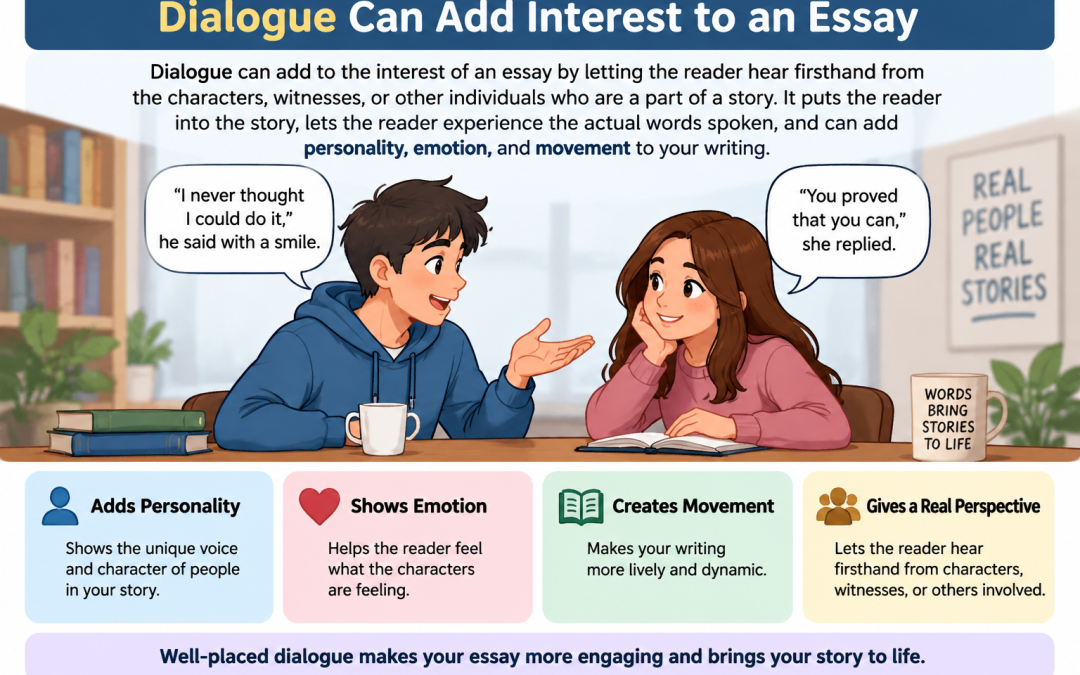
Dialogue can add to the interest of an essay by letting the reader hear firsthand from the characters, witnesses, or other individuals who are a part of a story. Dialogue puts the reader into the story, lets the reader experience the actual words spoken, and can add personality, emotion, and movement to your writing.
But, when you use dialogue in an essay, you have to do more than just surround words with quotation marks. Writing should include an understanding of when to use dialogue, punctuation, when to start a new paragraph and how to make dialogue sound like real speech.
This guide will teach students how to write dialogue in an essay, offer some samples and give the most important rules for the formatting of dialogue.
What is Dialogue in an Essay?
Dialogue is a narration in writing of the spoken words or actions of two or more persons. It enables the reader to be a part of a conversation instead of just reading about what took place.
For example:
Sarah checked the time. “Do we have ample time?”
“It will be OK,” Daniel said. “It’s still an hour before the train departs.”
The exchange provides a greater sense of immediacy than describing that Sarah queried Daniel about whether they had time.
There are three types of dialogue most writers will find.
Direct Dialogue
Direct Dialogue is the actual words of the speaker and often is set off with quotation marks.
Example:
“Yesterday I turned in the assignment,” Marcus said.
Indirect Dialogue
Indirect dialogue is used to tell what a person said without using their exact words.
Example:
Marcus said that he turned in the assignment the day before.
No quotation marks are needed since the writer is paraphrasing the speaker.
Internal Dialogue
The thoughts that a character tells himself is internal dialogue.
Example:
Maya thought that she should have been better prepared for this presentation.
However, in different styles of writing, the internal thoughts can be set in italics or can be part of the narration.
When Should You Use Dialogue in an Essay?
Dialogue is especially useful in narrative, personal, reflective, and creative essays. It can help recreate an important moment, reveal a character’s personality, or show conflict between people.
It may also be used selectively in other types of writing when quoting a conversation adds meaningful evidence or context.
However, dialogue should have a purpose. Adding conversations only to increase the word count can make an essay feel unfocused.
Before including a conversation, ask yourself:
- Does it reveal useful information?
- Does it develop a person or character?
- Does it move the story forward?
- Does it support the central idea of the essay?
Would the scene lose something important if I summarized it instead?
If the dialogue does not serve one of these purposes, paraphrasing may be the better choice.
Essential Dialogue Formatting Rules
Learning the basic dialogue formatting rules will help make conversations clear and professional.
1. Put Direct Speech in Quotation Marks
Use quotation marks around the exact words spoken by a person.
Correct:
“I need another day to finish the report,” Amy said.
Incorrect:
I need another day to finish the report, Amy said.
Quotation marks help readers immediately distinguish spoken words from narration.
2. Start a New Paragraph When the Speaker Changes
Each time another person starts speaking, begin a new paragraph.
For example:
“Did you finish the research?” Liam asked.
“Almost,” Noah replied.
“When will it be ready?”
“By tomorrow morning.”
Even very short responses should normally begin on a new line when the speaker changes.
3. Place Punctuation Correctly
In American English, commas and periods associated with dialogue generally appear inside the closing quotation marks.
Example:
“I understand the instructions,” she said.
When a dialogue tag follows the quotation, use a comma rather than a period if the sentence continues.
Example:
“We should leave now,” James said.
4. Keep Question Marks and Exclamation Marks With the Spoken Words
When the speaker is asking a question, the question mark remains inside the quotation marks.
Example:
“Where did you put my notes?” Sophia asked.
The same principle applies to exclamation marks.
Example:
“Watch out!” he shouted.
5. Capitalize the Beginning of Dialogue
The first word of a complete piece of dialogue should normally begin with a capital letter.
Example:
The teacher said, “Your final draft is due next Monday.”
6. Use Single Quotation Marks for a Quote Inside Dialogue
If a speaker quotes another person, single quotation marks can be used inside the main double quotation marks.
Example:
“My professor said, ‘Review Chapter Five before class,’ so that’s what I’m doing,” Henry explained.
These basic dialogue formatting rules help readers identify who is speaking and understand how the conversation connects with the surrounding narration.
How to Write Dialogue in an Essay Naturally
While punctuation is crucial, it is also important that dialogue is believable.
Spoken Language Writing
In real conversations, there are no pre-arranged scripts. Contractions, short responses, pausing and incomplete sentences.
Dialogue that is too formal may sound unnatural.
Less natural:
“Do you want to go to the library at the university this afternoon?”
More natural:
“Would you like to visit the library today after school?”
It’s not about transcribing all the hesitations and filler words from authentic speech. Rather, fashion a tidy rendition of natural speech.
Keep Conversations Focused
Extended explanations can cause an essay to drag. Aim for some purposeful contributions to each line.
Consider this:
“I told him.” Rebecca shut her Notebook. “He simply wouldn’t listen.”
A short dialogue with the action is better than multiple sentences of the same action.
Don’t Overuse Dialogue Tags!
Dialogue tags are used to tell who is talking.
Common examples include:
- said
- asked
- replied
- answered
- whispered
- shouted
There’s nothing wrong with using “said.” Indeed, it is frequently the best choice, as the reader is hardly aware of it.
Some writers change all instances of “said” to such alternatives as “declared,” “exclaimed,” “announced,” and “interjected.” Excessive number of fancy tags can be distracting to readers.
Sometimes you can get rid of the tag altogether if it is clear who is speaking.
Example:
“So you knew about this?
Michael looked away.
“For three weeks.”
In the action, the speaker should be obvious without the addition of another “he said.”
Give Each Speaker a Distinct Voice
Strong dialogue reflects the personality of the person speaking.
A nervous student may speak differently from a confident professor. A teenager may choose different words than a senior manager.
For example:
“I suppose we could submit it tomorrow, if that works for everyone?”
Compared with:
“Tomorrow. We’ll submit it then.”
Both sentences communicate a similar idea, but they suggest very different personalities.
When reviewing dialogue in an essay, remove the names and dialogue tags temporarily. If every character sounds exactly the same, their voices may need more differentiation.
Dialogue and Action Should Work Together
Conversations become more interesting when they interact with physical actions.
Instead of:
“I don’t believe you,” Claire said angrily.
Try:
Claire pushed the chair away from the table. “I don’t believe you.”
The action shows the emotion instead of explaining it directly.
This technique can make narrative writing more vivid while reducing unnecessary adverbs.
Common Dialogue Writing Mistakes
Students learning how to write dialogue in an essay should watch for several common problems.
Using Dialogue Without a Purpose
Every conversation should support the story, argument, or main idea.
Forgetting New Paragraphs
When a new person speaks, start a new paragraph. Otherwise, readers may struggle to identify the speaker.
Incorrect Punctuation
Check commas, quotation marks, question marks, and dialogue tags carefully.
Making Every Character Sound the Same
Vocabulary, sentence length, confidence, and tone can help differentiate speakers.
Overusing Dialogue
Dialogue should complement narration rather than replace it completely.
Using Too Many Fancy Tags
Simple dialogue tags are usually enough. Let the spoken words and surrounding actions communicate emotion.
How to Check Your Dialogue Before Submission
After finishing your essay, read the dialogue aloud. Hearing the words often reveals sentences that look acceptable on the page but sound unnatural when spoken.
Check that:
- Every speaker is easy to identify.
- New speakers begin new paragraphs.
- Quotation marks are properly placed.
- Punctuation follows the required style.
- Each conversation contributes something useful.
- Dialogue sounds appropriate for each speaker.
- Conversations do not overwhelm the rest of the essay.
If a student struggles with dialogue, structure, citations or academic formatting, they can also opt for the help from an essay writing company. If you make use of external academic support, make sure you select the appropriate services and that any support is provided in line with your institution’s academic-integrity guidelines. The best explanation of structure, review of drafts and understanding of how to upgrade one’s own work can be provided by a professional assignment writer or a writing tutor.
Final Thoughts
Knowing how to write dialogue in an essay is simply a matter of balancing proper formatting with believable dialogue. Always use quotation marks for direct speech, begin a new paragraph for a new speaker, close the quotation marks correctly and make conversations short.
Most importantly, ensure that there is a justification for each exchange. Dialogue in an essay can show personality, cause tension, convey vital information, and give a simple description a memorable scene.
After learning the fundamental rules for dialogue formatting, the only way to get better is to practice. Read back your conversations, eliminate all the “fillers,” and ensure that all of the participants have a voice that can be heard.
FAQ
What is the correct way to quote dialogue in an essay?
Direct speech should be in quotation marks, and a new paragraph should be used to indicate a change in voice. Use punctuation and quotation marks as necessary.
Is there a new paragraph for dialogue?
Yes. Generally, each new speaker should start a new paragraph. This helps the conversation to flow.
Are quotation marks punctuated?
Commas and periods in American English are used inside the quotation marks. When they belong to the spoken sentence, question marks and exclamation marks are also used within.
Can dialogue be used in academic essays?
Dialogue is used primarily in narrative, personal, reflective and creative essays. Usually, in formal academic writing, it is more common for direct quotations from scholarly sources to be used than conversational dialogue.
What are the key rules for dialogue?
Using quotation marks for direct speech, starting a new paragraph for each speaker, using the right punctuation when writing dialogue, capitalizing the first word in spoken sentences, and using dialogue tags correctly are the most important rules for dialogue formatting.