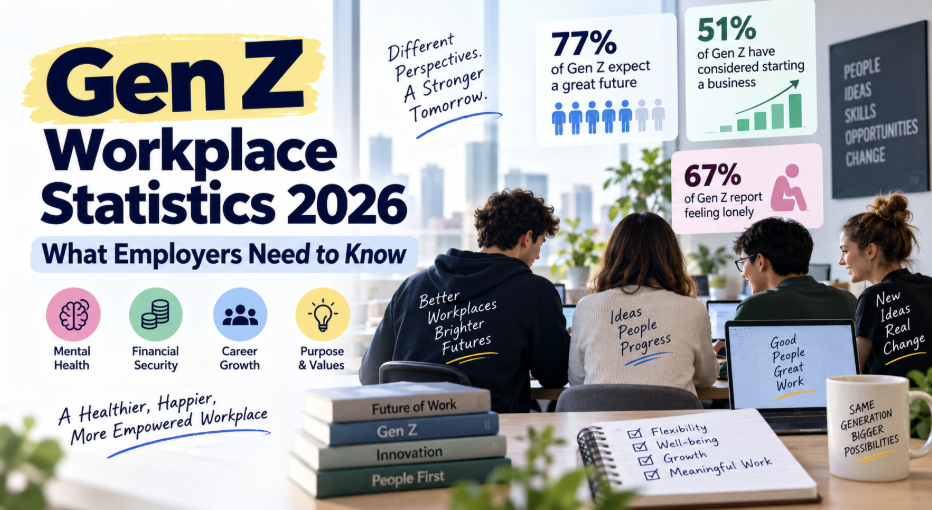
Generation Z is no longer simply the youngest group entering the workforce. Its oldest members are approaching 30, moving into management positions, recruiting employees, and influencing how organizations define a desirable career.
The latest Gen Z workplace statistics suggest that this generation is reshaping employment around a different set of priorities. Mental well-being, financial stability, flexible working conditions, transparency, personal values, and meaningful career development now sit at the center of many employment decisions.
Meanwhile, the cost of living, doubts regarding traditional institutions, lack of entry-level positions, and the increasing worry over long-term financial security are all plagues on Gen Z.
Knowing these forces can assist employers answer an increasingly important question: what Gen Z wants from work in 2026.
Who Is Gen Z?
The general age range of those who fall under the label of Gen Z is 1997-2012. In 2026, its members will be around 14 to 29 years old.
This generation experienced an atypically turbulent childhood. A greater integration with digital technology in everyday life from childhood, a revolution in communication through social media, the COVID-19 pandemic and the disruption of education and early careers, and increased living and housing costs making it harder to become financially independent.
These experiences give rise to the fact that Gen Z workers are different when it comes to work.
They are super-entitled: digital, but many are lonely. They are interested in promotion but don’t want to put their health at risk. They seek to have their employers set clear values and financial pressures are causing salary and job security to become more important.
Mental Health Remains a Major Challenge
One of the most consistent themes that has come through the various Gen Z studies is mental health.
Approximately 40% of the Gen Z respondents say that they sometimes feel anxious and sometimes feel very anxious most of the time. Only about half speak positively about their general health.
Burnout seems particularly high. According to one set of findings, 72% of Gen Z experience burnout while 38% of Baby Boomers do.
But there’s another story. Previous generations seem reluctant to use mental-health services, whereas younger workers do not. Approximately 26% had a mental-health benefit in the month before the survey.
Entrepreneurship Is Becoming More Attractive
Gen Z are not the only ones thinking outside the box when it comes to employment.
Some 51% of Gen Z respondents said they thought about starting a business in the past year. The proportion was approximately 27% for adults in general.
It is a substantial difference.
Entrepreneurship signifies independence and drive to some. For some, it might be because of the uncertainty of the job market.
Younger workers can find alternatives to working the corporate ladder through freelancing, online work, digital services, creator-led careers, and small startups.
Gen Z Is Still Optimistic About the Future
Gen Z, despite all the anxiety and lack of well-being and finances, is not all doom and gloom.
Approximately 77% feel they can have a good future and 56% feel ready for the future.
Compared to 2023, the figure for preparedness has risen significantly.
This presents an intriguing paradox: that today Gen Z might feel insecure about their current situation while they feel optimistic about their prospects.
Employers should not assume that if someone seems to be experiencing burnout or fears they are not secure in their job, that they lack drive. Younger workers might prefer to have an important career, but they have a different definition of success.
Gen Z Is Not One Uniform Group
Talking about an entire generation can hide major differences within it.
Age is one dividing line. Younger Gen Z students tend to report greater optimism than adults who have already encountered rent, debt, layoffs, workplace pressures, and the realities of the employment market.
Around 84% of Gen Z students reportedly express optimism about their future, compared with roughly 73% of Gen Z adults.
Gender differences have also become more visible.
Recent data presented in the source shows considerable gaps between young men and women in political identification and approval measures.
Gen Z Gender Differences
|
Measure |
Gen Z Men |
Gen Z Women |
|
Identify as Democrat |
~33% |
52% |
|
Identify as Republican |
38% |
20% |
|
Approve of Trump’s job performance |
47% |
26% |
These differences illustrate why employers should avoid designing workplace policies around a stereotype of the “typical Gen Z employee.”
People within the generation can hold significantly different social, economic, and political attitudes.
A Connected Generation Is Also a Lonely Generation
One of the most surprising findings concerns loneliness.
Gen Z has access to constant digital communication, yet it reports some of the highest levels of loneliness among all generations.
The 2025 data cited in the source classified 67% of Gen Z as lonely. Millennials followed closely at 65%, while the proportion declined among older groups.
Loneliness by Generation
|
Generation |
Classified as Lonely |
|
Gen Z |
67% |
|
Millennials |
65% |
|
Gen X |
60% |
|
Baby Boomers |
44% |
Loneliness and social isolation are not the same thing.
A person can communicate with hundreds of people online and still feel that meaningful relationships are missing. This distinction may be particularly relevant to a generation whose social lives have been deeply shaped by digital platforms.
For employers, this creates an opportunity.
Structured onboarding, mentoring, collaborative projects, informal team interaction, and occasional face-to-face meetings can provide forms of connection that digital communication alone may not replace.
What Gen Z Wants From Work
The answer is increasingly clear: Gen Z wants a combination of balance, purpose, development, fair compensation, and transparency.
The Gen Z work-life balance statistics are particularly revealing.
In a global workforce study covering more than 26,000 employees across 35 countries, work-life balance overtook salary as the leading workplace motivator for the first time in the study’s history.
Among Gen Z, 76% reportedly prioritized work-life balance over salary, while 66% considered protecting their mental health a major priority.
That does not mean money has become unimportant.
Financial pressure has actually pushed compensation back toward the top of the agenda. Approximately 44% reportedly identify pay transparency as their most important job factor.
The message is not that Gen Z wants flexibility instead of money. It wants both.
Purpose Matters Too
Meaningful work has also become a major factor in job satisfaction.
Around 89% of Gen Z respondents say having a sense of purpose matters to their professional satisfaction.
Approximately 44% report leaving a job that did not provide enough purpose, while around 40% have rejected an employer, assignment, or project because it conflicted with their personal ethics.
At the same time, only a small percentage identify reaching senior leadership as their single most important objective.
This does not necessarily indicate weak ambition.
Another survey cited in the source found that 80% still aspire to senior leadership. The difference is that many want advancement without sacrificing health, personal values, or their life outside work.
Gen Z Expects Employers to Be Transparent
Organizations trying to attract younger workers should pay close attention to transparency.
Gen Z has grown up with access to salary databases, employer reviews, online professional communities, social platforms, and instant information about workplace practices.
Trying to hide salary ranges or relying on vague promises about culture is therefore becoming less effective.
Younger candidates increasingly expect organizations to explain:
- Pay ranges
- Promotion opportunities
- Training programs
- Flexible-working policies
- Performance expectations
- Employee benefits
- Organizational values
Transparency creates trust, and trust is particularly important for a generation already skeptical of many institutions.
Values Influence Both Politics and Employment
The assumption that young people are politically disengaged does not match the participation figures cited in the source.
Approximately 47% of eligible young Americans voted in 2024, compared with 39% in 2016.
Nearly 50 million members of Gen Z are expected to be old enough to participate in the 2026 midterm elections.
Issue-based participation appears especially important.
When young respondents were asked how they were likely to support causes they cared about, the reported responses were:
|
Action |
Percentage |
|
Vote |
89% |
|
Discuss the issue with friends or family |
88% |
|
Sign a petition |
78% |
|
Join a boycott or protest |
57% |
|
Help register other voters |
52% |
That values-driven behavior does not disappear when Gen Z enters the workplace.
Sustainability Still Matters, but Price Matters Too
Environmental concerns remain important to Gen Z, but inflation and living expenses are creating a practical limit.
Around 70% reportedly consider an employer’s environmental record when making career decisions.
Approximately 65% say they are willing to spend more on sustainable products.
Yet willingness to pay an additional “green premium” has declined by around five percentage points since 2020.
This difference between stated values and purchasing behavior makes sense in the context of financial insecurity.
People may care deeply about sustainability while still choosing a cheaper product because rent, transportation, groceries, and student debt consume a large share of their income.
Sustainability and Gen Z
|
Measure |
Result |
|
Environmental record matters when choosing an employer |
70% |
|
Willing to pay more for sustainable products |
65% |
|
Willingness to pay a sustainability premium |
Down 5 points since 2020 |
One area where affordability and environmental values work together is secondhand shopping.
Resale and thrift markets allow consumers to spend less while reducing waste, which helps explain their popularity among younger buyers.
For brands, the lesson is straightforward: environmental claims need evidence, and sustainability needs to remain affordable.
What Employers Should Do in 2026
The Gen Z workplace statistics point toward several practical actions.
1. Protect the Entry-Level Career Path
Automation should not be used to eliminate all opportunities for young professionals to gain experience, but it should be able to remove repetitive tasks.
Junior positions can be restructured to focus on learning, problem-solving, AI supervision, communication, and analytical abilities.
2. Have a clear compensation policy.
Whenever possible, a salary range should be provided.
Younger employees struggling with cost-of-living expectations are more likely to seek clarification about a job before undergoing several stages of the interview.
3. Make Mental-Health Support Visible
If staff members aren’t comfortable with using the benefits, then they can’t be of help.
It is important for managers to encourage reasonable workloads, normalize support, and keep an eye out for recurring burnout.
4. Offer Genuine Flexibility
The statistics on Gen Z work-life balance reveal that flexibility is not a small reward anymore.
The use of hybrid working, fixed working hours, flexible working, and respect for work-life balance can all have a direct impact on recruitment and retention.
5. Provide Development Opportunities for Employees
Training and career development continue to be top considerations for hiring younger workers.
Companies must offer development opportunities as opposed to making vague statements about future opportunities.
6. Demonstrate Values Through Actions
Corporate statements are much less significant if there are no policies behind them.
Younger workers expect sustainability, fairness, diversity,y or social responsibility to be reflected in business decisions if it is promoted by an organisation.
What the Data Ultimately Says About Gen Z
Gen Z enters the workforce carrying several apparent contradictions.
- It is digitally connected yet highly vulnerable to loneliness.
- It values work-life balance but still wants career progression.
- It cares deeply about sustainability while becoming more sensitive to price.
- It is financially anxious but remains hopeful about the future.
And although younger workers may question traditional institutions, they still want employers they can trust.
That combination explains much of what Gen Z wants from work: fair compensation, flexibility, purpose, professional development, mental-health support, authentic values, and a realistic opportunity to build a career.
Employers that understand those expectations will be better positioned to attract and retain younger workers.
Organizations that continue relying exclusively on older assumptions about loyalty, hierarchy, and career success may find recruitment increasingly difficult.
A Note for Students Researching Gen Z
Students preparing reports about employment trends should compare several reliable studies rather than relying on a single statistic. They may also search for the best website for writing essays when they need guidance on research structure, argument development, or citation practices.
Similarly, custom assignment writing services may offer academic support, but students should use any external assistance in accordance with their institution’s academic-integrity rules and ensure that submitted work reflects their own learning.
Final Thoughts
Gen Z is beginning their adulthoods in an era of historic economic, technological, and social transformation.
Burnout, job insecurity, isolation, and uncertainty regarding their first job are high among the generation. It is, at the same time,e ambitious, entrepreneurial, values-conscious, and relatively optimistic about the future.
So, the lesson for the workplace isn’t that Gen Z is less demanding about a job.
It calls for a greater number of dimensions of the career to work together.
Pay must be fair. Flexibility has to be for real. There needs to be a clear purpose. Mental-health support should be accessible to use. There need to be development opportunities. But corporate values need to be displayed, not just promoted.