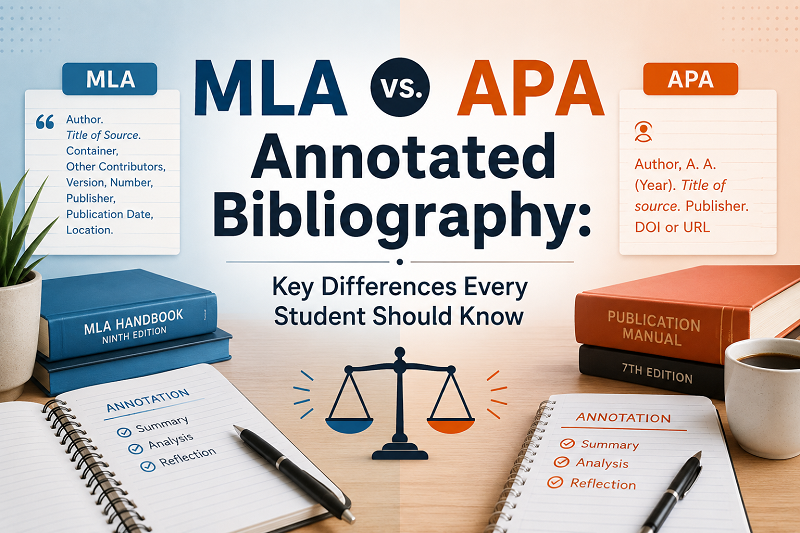
Annotated bibliographies are important academic writing tools because they help students show the quality, relevance, and usefulness of the sources they have selected for research. Students often become confused about how to format an annotated bibliography in APA. Both styles have different rules for citation order, punctuation, headings, spacing, and the way source details are presented. Understanding these differences can save time, reduce mistakes, and improve academic marks.
What Is an Annotated Bibliography?
An annotated bibliography is a bibliography that consists of a list of sources with short notes, called annotations, that summarize or evaluate each source. Typically these annotations describe what the source is about, why it is useful and how it relates to the research topic. In certain assignments, the annotation can just be a summary of the source. It may also, in other assignments, assess the credibility of the author, compare the source to other sources or elucidate how the source will be utilized in the paper.
There are certain rules in APA related to the list of references, hanging indents, publication year and author names, which is why many students search the web for how to format an annotated bibliography in APA.
Main Purpose of MLA and APA Annotated Bibliographies
The goal of either MLA or APA annotated bibliographies is to demonstrate that the student has done good research. Each style, however, is commonly used in various academic disciplines. MLA is primarily used in literature, language, cultural studies and subjects in the humanities. APA is typically used in the psychology, education, social science, business and health-related fields.
In MLA style, the emphasis is placed on the author and the work. This applies to subjects where there is a consideration of interpretation, language and literary analysis. The publication date is very important in APA style because a lot of subjects that use APA rely on most recent research, experiments and updated findings.
By mastering the APA vs MLA citation style differences, students will be able to select the appropriate style for their specific subject area, teacher’s guidelines, and/or assignment requirements.
MLA Annotated Bibliography Format
Normally the author’s last name is first, followed by the first name. Next the name of the source, container information, publisher, publication date and other information as needed for the particular type of source. The title for a typical MLA-style list of works cited is “Works Cited.” For an annotated bibliography, teachers can request the title “Annotated Bibliography.”
Students who are having trouble evaluating sources, structuring their citations or academic formatting requirements might utilize annotated bibliography writing service.
APA Annotated Bibliography Format
The difference with APA format is that the year of publication is listed right after the author’s name. This is because APA makes sure to appreciate freshness and relevance of research. The basic components of an APA Style reference are: author(s), year of publication, title of source, journal or publisher, volume and issue information (if applicable), page numbers, and DOI or URL (if applicable).
Students frequently ask how to format an annotated bibliography in APA because capitalization, italics, the format of DOIs (digital object identifiers), and the order of references must all be taken into careful consideration when formatting with APA.
For APA, the annotation is placed underneath the reference entry. May include a summary of the purpose, methods, results and usefulness of the source. APA citations are particularly likely to be used when students have assignments that involve research, and they must explain the reliability and academic value of each source.
MLA vs. APA Format: What Makes Them Different?
The only major distinction between an MLA and an APA annotated bibliography is the placement of the information for citations. The difference in MLA vs APA is the emphasis on the author and title in MLA and author and date is APA. This distinction is based upon the academic disciplines in which each style is employed. Often, the focus of humanities subjects is interpretation and authorship, and often the focus of social sciences subjects is recent research and evidence.
An additional important distinction is capitalisation. Title case is used for source titles (major words must be capitalized) as is the case with MLA. The title of an article is typically written in sentence case (first word capitalized, all other words lower case), unless a proper noun or the first word following a colon is involved. It is an area in which students often make errors.
In-text citations are also an area that shows differences between MLA vs APA citation style. Typically the author’s last name and page number are used for MLA, and the author’s last name and publication year are used for APA, and occasionally the page number, for direct quotations.
APA vs MLA Citation Style Differences
| Point | MLA | APA | Interesting Stat/Fact | ||
| Current Guide | MLA Handbook | APA Manual | MLA is on 9th edition; APA is on 7th edition | ||
| Common Use | Humanities | Social sciences | MLA is common in literature; APA is common in psychology | ||
| In-Text Style | Author + page | Author + year | Both usually use 2 key details | ||
| Example | (Smith 25) | (Smith, 2022) | APA highlights date more than MLA | ||
| Citation Page | Works Cited | References | Each style has a different final page title | ||
| Author Name | Smith, John | Smith, J. | APA shortens first names to initials | ||
| Title Style | Title Case | Sentence case | This is one of the most common student mistakes | ||
| Date Placement | Near the end | After author | APA puts date earlier for research relevance | ||
| Annotation Focus | Summary + meaning | Methods + credibility | APA is more research-focused | ||
| Best For | Text analysis | Evidence-based work | Choose style based on subject area | ||
Why Students Need to Learn Both Styles
It is helpful to know both MLA and APA as students may be studying various courses in college or University. In an English literature class, a student can use MLA and in a psychology or business class, the student can use APA. By doing both styles, students will be more flexible and confident in their writing for academic purposes.
The student who knows how to format an annotated bibliography in APA can create better research papers which are needed in subjects with new sources, research studies, evidence based writing and so on.
Meanwhile, students who know MLA can compose superior humanities papers, particularly in the analysis of books, essays, poetry, films and cultural texts. Both styles will help students learn how to honor academic honesty and properly credit the original author(s).
If the deadline is too near, some students seek help with annotated bibliography writing service, though in both cases, it is important to grasp the fundamental guidelines and be able to assess the results and learn from the experience.
Common Mistakes Students Should Avoid
A common error is using both MLA and APA guidelines on the same assignment. An APA reference presented in a student’s work, for instance, might have MLA capitalization. Other errors include omission of the hanging indent and too brief and/or too cryptic annotations.
It is also important for the students to refrain from citing unreliable sources. The annotated bibliography should consist of sources that are considered credible academic sources, including books, peer-reviewed journals, official reports and trusted websites. Weak sources may diminish the quality of the overall assignment.
Students can reduce these issues and turn in a cleaner, more professional piece of academic work, by understanding APA vs MLA citation style differences.
Conclusion
MLA and APA annotated bibliographies may look similar at first because both include citations and annotations, but their rules are clearly different. MLA is mostly used in humanities subjects and focuses on authors, titles, and textual analysis. APA is commonly used in social sciences and focuses on dates, research methods, and updated evidence.
Using a buy critical thinking essay service may help students understand structure and formatting, but learning the rules personally is the best way to improve academic confidence and avoid citation mistakes.